Showing posts with label cosmology. Show all posts

Tuesday, 9 June 2026

Anti-Quark Nuggets

This idea of quark nuggets was recently discussed in a YouTube video by Sabine Hossenfelder. I watched it but it now seems to be for members only. Not to worry, I asked Gemini a couple of questions. Its explanations were enlightening. I still don't fully understanding how the "biased cosmic sorting machine works" but it's given me food for thought.

Query: Can you comment on the concept of "quark nuggets" as an alternative to dark matter in explaining the missing mass of the Universe.

The concept of "quark nuggets" (and their modern theoretical iteration, Axion Quark Nuggets or AQNs) is one of the most elegant and fascinating alternatives to standard dark matter models. It is a compelling framework because it relies largely on the particle physics we already know, rather than inventing entirely new fundamental forces, and it attempts to solve two of cosmology's biggest mysteries simultaneously.

Here is a breakdown of what they are, how they explain the missing mass of the universe, and where the science currently stands.


What Are Quark Nuggets?

Unlike mainstream dark matter candidates like Weakly Interacting Massive Particles (WIMPs), which are theorized to be single, fundamental particles, quark nuggets are hypothetical composite objects.

  • The Composition: First proposed in the 1980s by physicist Edward Witten, these nuggets are thought to be composed of "strange quark matter"—an ultra-dense, completely stable soup of up, down, and strange quarks.
  • The Density: They would be unimaginably dense, packing the mass of a golf ball (or up to a few kilograms) into a sphere just a micrometer across, which is smaller than the width of a human hair.
  • The Origin: They theoretically formed in a fraction of a second after the Big Bang during the quark-hadron transition, when the primordial universe cooled enough for loose quarks to condense.

How Do They Solve the Missing Mass Problem?

To be a viable dark matter candidate, an object must be massive enough to exert a strong gravitational pull, but "dark" enough that it doesn't interact easily with light or normal matter. Quark nuggets fit this profile perfectly.

  • Gravitational Influence: Because of their immense density, a vast distribution of these nuggets floating throughout a galaxy would provide the exact gravitational scaffolding needed to keep stars from flying apart, seamlessly accounting for the missing mass.
  • Electromagnetic Invisibility: Despite being made of quarks (the same building blocks that make up visible matter like protons and neutrons), they are so dense and tightly bound that their cross-section for interacting with light is practically zero. To a telescope, a swarm of quark nuggets would appear completely invisible and behave exactly like cold dark matter.

The Antimatter Bonus

The most powerful aspect of the modern Axion Quark Nugget model is that it naturally addresses the matter-antimatter asymmetry of the universe.

  • Hiding the Antimatter: Standard cosmological models struggle to explain why the observable universe is filled with matter and completely devoid of antimatter. The AQN framework suggests that during the early universe, dark matter was formed as a mix of both matter-nuggets and antimatter-nuggets.
  • Cosmic Balance: By sequestering massive amounts of antimatter safely inside the impenetrable cores of these ultra-dense nuggets, the theory explains where all the missing antimatter went. This elegantly links the total abundance of dark matter directly to the abundance of visible matter:$$ \Omega_{\text{DM}} \sim \Omega_{\text{visible}} $$as both were generated by the exact same early-universe event.

Current Research and Detectability

While quark nuggets remain a niche alternative compared to mainstream candidates, they are an active area of astrophysical research because they are uniquely detectable through standard astronomy.

  • The Galactic Glow: Recent studies suggest that when interstellar gas or ordinary matter occasionally collides with an antimatter quark nugget, the resulting matter-antimatter annihilation should produce a very specific, faint far-ultraviolet (FUV) glow.
  • Observational Matches: Astronomers have recently confirmed an unexplained surplus of FUV light across the Milky Way using instruments aboard spacecraft like New Horizons. The theoretical radiation output of quark nugget collisions perfectly matches this mysterious galactic background light.
  • CMB Distortions: The energy injected by these interactions in the early universe may also leave distinct, testable spectral signatures in the Cosmic Microwave Background, which future high-resolution space missions are aiming to detect.

Ultimately, while quark nuggets are still a theoretical alternative, they provide a scientifically rigorous perspective on the cosmos. Instead of requiring the existence of "ghost particles" that completely ignore the known laws of the universe, they suggest that dark matter might just be standard quarks organized in an unimaginably dense, macroscopic way.

Source

Query: Can you clarify as to how the possibility of quark nuggets solves the absence of antimatter in a universe apparently dominated by matter.

It is a brilliant question because it highlights how the quark nugget framework fundamentally flips our standard cosmological assumptions on their head. Standard physics assumes the antimatter is gone—destroyed in the earliest moments of the universe. The Axion Quark Nugget (AQN) theory, however, suggests the antimatter is still here; it was simply packaged away into inescapable vaults.

The Standard Dilemma: Annihilation

According to the standard model of the Big Bang, the universe should have created matter and antimatter in a perfect 1:1 ratio. However, matter and antimatter annihilate upon contact, leaving behind only pure energy (photons). If the universe was perfectly balanced, everything should have annihilated, leaving a universe filled with light but completely devoid of stars, planets, or people.

To explain why we exist, mainstream physics assumes a mechanism called Baryogenesis occurred. This theory posits that some unknown process created a tiny imbalance—roughly one extra particle of matter for every one billion matter-antimatter pairs. The billions annihilated, and that tiny remaining fraction of "leftover" matter formed the visible universe. The antimatter, in this view, is truly gone.

The AQN Alternative: The Cosmic Sorting Machine

The Axion Quark Nugget model offers a completely different narrative: the universe is still perfectly balanced between matter and antimatter. The antimatter was never destroyed; it was separated and compressed.

This happened during the Quantum Chromodynamics (QCD) phase transition, a fraction of a second after the Big Bang, when the universe cooled just enough for free-floating quarks to begin binding together.

  1. The Axion Network: As the universe cooled, a hypothetical field called the axion field formed a vast, invisible network of bubbles or "domain walls."
  2. The Collapsing Bubbles: These domain walls were highly unstable and began to violently collapse inward, trapping the hot soup of free quarks and antiquarks inside them.
  3. The Sorting Effect: This is where the magic happens. Due to a complex but well-documented physics principle known as CP (Charge-Parity) violation, the boundaries of these collapsing walls acted like a biased cosmic sorting machine. As the walls shrank, they preferentially swept up and trapped antiquarks much more efficiently than normal quarks.

The Cosmic Balance Sheet

The immense pressure of the collapsing walls crushed the trapped antiquarks into ultra-dense, stable spheres—the antimatter quark nuggets.

Meanwhile, because the collapsing walls preferentially locked away the antiquarks, a surplus of normal, un-trapped quarks was left floating freely outside the nuggets. These "loose" quarks eventually cooled to form the protons and neutrons that make up all the visible matter in the universe today.

In physics, matter is tracked by its "Baryon number" ($B$). Matter has a positive $B$, and antimatter has a negative $B$. The AQN model proposes a beautifully balanced universe where the total Baryon number is exactly zero:

$$B_{\text{total}} = B_{\text{visible}} + B_{\text{nuggets}} + B_{\text{anti-nuggets}} = 0$$

The massive negative Baryon number locked inside the anti-nuggets perfectly cancels out the positive Baryon number of the visible universe (and the smaller number of normal-matter nuggets that also formed). We perceive a matter-dominated universe simply because we are made of the leftover "loose change" that wasn't locked in the vault.

Why Isn't the Universe Exploding?

If the universe is secretly filled with antimatter, one might wonder why it isn't constantly exploding as it bumps into normal matter.

The answer lies in their extreme density. An anti-nugget with the mass of a boulder would be physically smaller than a bacterium. Because their surface-area-to-mass ratio is virtually zero, their cross-section for interacting with normal matter is incredibly tiny.

Furthermore, these anti-nuggets possess a positron "electrosphere" (a cloud of anti-electrons). When normal interstellar gas encounters an anti-nugget, it annihilates only at this microscopic surface boundary. This produces a continuous, incredibly faint glow of far-ultraviolet radiation—which perfectly matches the mysterious background glow our deep-space telescopes are currently observing—rather than catastrophic, universe-shaking explosions.

Saturday, 14 November 2020

Cold Dark Matter

Given my current interest in the non-existence of dark matter, it was interesting to come across this recent (2nd November 2020) article on the BBC website:

Durham University Prof Carlos Frenk's prize a 'huge honour'

A cosmologist who helped shape understanding of dark matter and the structure of galaxies has been awarded a top physics prize. Prof Carlos Frenk has been awarded the 2020 Paul Dirac Medal and Prize for theoretical physics by the Institute of Physics (IoP). The Durham University researcher was one of the originators of the Cold Dark Matter (CDM) theory. It is the second year in a row a Durham professor has won the award. A university spokesman said research carried out by Prof Frenk and his Durham colleagues had "created an internationally-renowned capability for predicting the observable properties of galaxies in a CDM universe".

Following up on this mention of cold dark matter, I discovered that there are two other proposed forms of this elusive substance: hot dark matter and warm dark matter. I kid you not. Not only do some cosmologists postulate dark matter but they haggle over whether it is cold, warm or hot. Currently, most of the money is on cold dark matter (CDM). Reading the BBC article, you'd have no idea that there is a crisis in cosmology but then again if you read the BBC exclusively you'd have no idea about anything. It really is an execrable news outlet.

However, now I'm finding out more about the doubts surrounding dark matter, YouTube is throwing up some relevant links. Here is one that I came across today from Sabine Hossenfelder:


There are variations on even the CDM universe. For instance, this article postulates a Lambda-CDM model:

Dark matter and dark energy may really be one "dark fluid" with negative mass 

The Standard Model of particle physics is currently our best understanding of how the universe works – but it only describes about five percent of everything in it. The rest is made up of what we call dark matter and dark energy, which are so far only known through their gravitational interactions with regular matter. Now, an astrophysicist from Oxford has put forward a new theory that suggests that dark matter and dark energy are actually part of the same phenomenon: a "dark fluid" with negative mass that fills the universe.

In a way, dark matter and dark energy are both placeholder concepts, plugging holes between the Standard Model and what we actually observe. For instance, the observed movement and distribution of galaxies doesn't make sense if their mass is limited to the stuff we can see. Since the 1930s, this hidden extra mass has been dubbed dark matter.

Dark energy is a more recent concept. The observation that the expansion of the universe seems to be accelerating was only made in 1998, when it was discovered that more distant objects are moving away from us faster than those closer by. The mysterious force that drives this, which we still know very little about, is now referred to as dark energy.

Taken together, dark matter and dark energy form the basis of our current standard model of Big Bang cosmology, the Lambda-CDM model. The Lambda in that name denotes dark energy as a kind of cosmological constant, while CDM stands for "cold dark matter," which seems to be the most accurate theory of the stuff – it's "cold" because it moves relatively slowly and interacts fairly weakly with ordinary matter.

Dark matter and dark energy have always been treated as separate entities, but are they in fact two sides of the same coin? That's the core idea behind the new theory put forward by Oxford astrophysicist Jamie Farnes, which may expand on the Lambda-CDM model.

Well, cosmology is in an interesting state at the moment with several competing theories. I like the description of dark matter and dark energy as being both placeholder concepts, which is pretty much what they are. They've been put in place while we wait for something sensible to replace them. Now, in addition to dark matter and dark energy, we have dark fluid with negative mass (whatever that means). Things are getting sillier and sillier.

ADDENDUM: November 24th 2020

Just to emphasise the madness, the following article from Quanta Magazine begins:

The Search for Dark Matter Is Dramatically Expanding

Physicists plan to leave no stone unturned, checking whether dark matter
tickles different types of detectors, nudges starlight,
warms planetary cores or even lodges in rocks.

The following graphic from the article identifies the main suspects:

Tuesday, 10 November 2020

The Real Crisis in Cosmology

I was delighted to discover a series of videos today that questions whether there ever was a so-called Big Bang that marked the creation of the observable universe. The videos are presented by Eric J Lerner who in 1991 wrote a book titled The Big Bang Never Happened: A Startling Refutation of the Dominant Theory of the Origin of the Universe. Almost thirty years on, he has not softened his position and in fact he maintains that additional information garnered during that time has eroded the credibility of the Big Bang theory even further. 

The article about him in Wikipedia begins:

Eric J. Lerner (born May 31, 1947) is an American popular science writer, and independent plasma researcher. He wrote the 1991 book The Big Bang Never Happened, which advocates Hannes Alfvén's plasma cosmology instead of the Big Bang theory. He is founder, president, and chief scientist of Lawrenceville Plasma Physics, Inc. In January 2020, Eric Lerner proposed the "Galactic Origin of Light Elements" (GOLE) hypothesis, an alternative model to the Big Bang theory, to help explain the beginnings of the universe.


His series of videos on YouTube are as follows (episode notes are copied from the YouTube channel):

  1. Episode 1  In the first episode of the series, Lerner focuses on the new work he presented at the January, 2020 meeting of the American Astronomical Society showing that the Big Bang theory of the origin of light elements has been increasingly refuted by data on the abundance of both lithium and helium.

  2. Episode 2  In episode 2 of the Real Crisis in Cosmology, LPPFusion Chief Scientist Eric Lerner shows that the abundance of light elements—helium, deuterium and lithium—can be explained without a Big Bang through the Galactic Origin of Light Elements (GOLE). Helium originates in thermonuclear reactions in stars in forming galaxies, while deuterium and lithium are formed by collisions of cosmic rays with hydrogen, helium, carbon and oxygen nuclei. Theories formulated over 30 years ago have made correct predictions, some of which have been confirmed only in recent years. Lerner shows how these theories, combined with more recent observations that most cosmic rays collide with the stars that accelerated them,  solve a growing mystery of why there are so many more high energy neutrinos than high energy gamma rays. The certainty that large amounts of light elements were produced by galactic processes makes the contradiction between Big Bang predictions and observation even worse. Therefore the universe could never have gone through a period of simultaneous high temperature and high density. In other words, the Big Bang never happened. 

  3. Episode 3  In episode 3 of the Real Crisis in Cosmology, LPPFusion Chief Scientist Eric Lerner shows that the largest objects in the universe, vast conglomerations of superclusters of galaxies, are much too large to have formed in the 14 billion years since the hypothesized Big Bang. The universe is too old for a Big Bang!

  4. Episode 4  In episode 4 of the Real Crisis in Cosmology, LPPFusion Chief Scientist Eric Lerner explains observations that show that Dark Matter does not exist. The Big Bang hypothesis needs Dark Matter. But we can shed some light on this matter, making it clear it isn’t there.

  5. Episode 5  In episode 5, LPPFusion Chief Scientist Eric Lerner explains how cosmic evolution occurred without a Big Bang. Based on theories first developed by Physics Nobel Laureate Hannes Alfven, this evolution can be understood as occurring through electromagnetic and gravitational processes that are well understood here on Earth, without any mysterious dark energy, dark matter or inflation.

Having watched all five episodes now, I'm happy to say that Lerner is completely dismissive of the idea of dark matter, dark energy and inflation. I've never felt comfortable with these contrived notions of how the universe works and now here is a cosmologist who has a plausible alternative to explain things.

Saturday, 2 February 2019

Dark Days for Dark Matter?


Photo from https://www.zazzle.com/dark+matter+clothing


The article below appeared in The Conversation on February 1, 2019. I was drawn to it because I've always been suspicious of the notions of dark matter and dark energy. The article below proposes that a modification to how gravity works may eliminate the need to include unseen and undetected dark matter and energy in cosmological modelling. 


****************************

Dark matter may not actually exist – and our alternative theory can be put to the test

Juri Smirnov, University of Southern Denmark

File 20190125 108342 2nf65f.jpg?ixlib=rb 1.1
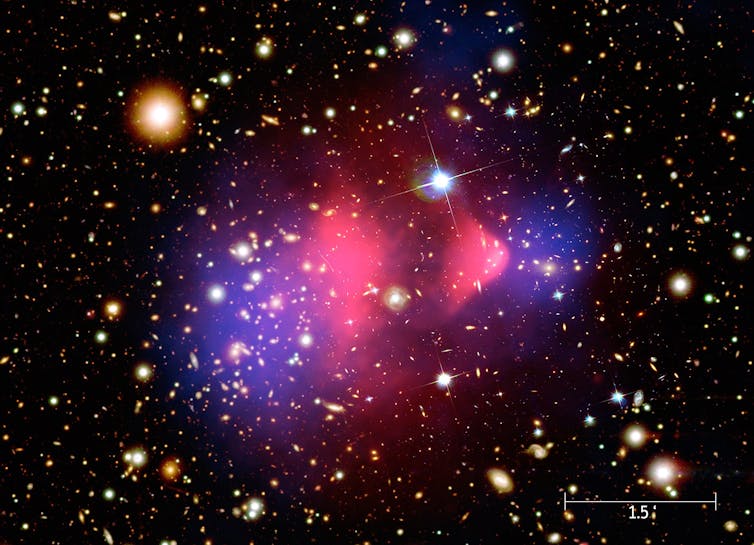
The bullet cluster. NASA/CXC/M. Weiss
Scientists have been searching for “dark matter” – an unknown and invisible substance thought to make up the vast majority of matter in the universe – for nearly a century. The reason for this persistence is that dark matter is needed to account for the fact that galaxies don’t seem to obey the fundamental laws of physics. However, dark matter searches have remained unsuccessful.

But there are other approaches to make sense of why galaxies behave so strangely. Our new study, published in the Journal of Cosmology and Astroparticle Physics, shows that, by tweaking the laws of gravity on the enormous scales of galaxies, we may not actually need dark matter after all.

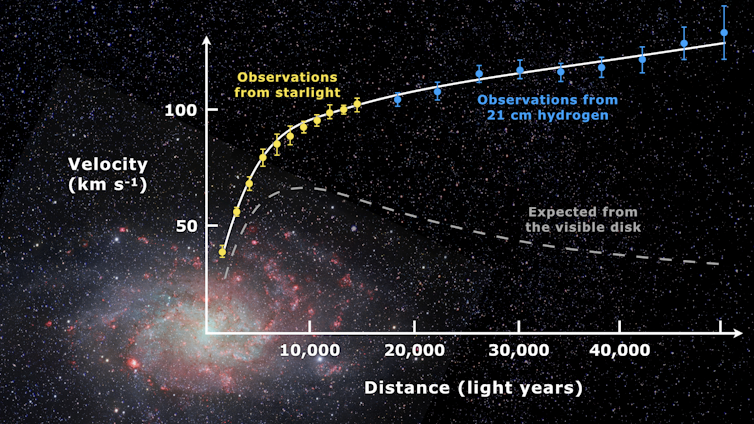
The Swiss astronomer Fritz Zwicky discovered in the 1930s that velocities in galaxy clusters were too high to account for how much matter we could see. A similar phenomenon was described by several groups of astronomers, such as Vera Rubin and Kent Ford, when they studied the motion of stars at the far edges of the Andromeda Galaxy.

The velocities of the stars far from its centre were expected to decrease, as they experience less gravitational force. That’s because, according to Newton’s second law of motion, the gravitational pull on orbiting matter can be equated to a product of its mass and acceleration (which is related to velocity).


Rotation curve of spiral galaxy Messier Triangulum. 
Mario De Leo/wikipedia, CC BY-SA

However, the measurements showed that there was no such decrease in velocities with distance. That led scientists to believe there must be some invisible matter there to create a stronger gravitational pull and faster stellar motion. In the past decades, countless other probes of gravitating systems at very large length scales indicated the same problem.

Beyond dark matter


The mystery of what dark matter actually is remains the ultimate challenge of modern fundamental physics. The core question is whether it is indeed a missing mass source, such as a new type of matter, or whether the gravitational law is simply different at gigantic length scales.

While the first option seems very tempting, we haven’t actually found any dark matter yet. Also, while gravity laws are well tested within the solar system, one has to be careful extrapolating this to scales which are at least one billion times larger.

One well known attempt to get rid of the need for dark matter is Modified Newtonian Dynamics (MOND), which suggests that Newton’s law of gravity becomes irregular when the gravitational pull is very weak – as is the case in the outer regions of the galaxy. But this theory, although successful in many respects, hasn’t passed the same stringent tests as our standard model of cosmology, which includes dark matter.

The main problem is that MOND cannot explain the missing mass problem in galaxies and galaxy clusters at the same time. Another very strong argument against MOND is based on the observation of colliding galaxy clusters, where the stars of each galaxy pass through each other, but the gas clouds stick together and stay behind. A famous example is the Bullet Cluster, which consists of two such colliding clusters. Observations suggest that dark matter follows the stars in these events, which have a lower total mass than the gas cloud. MOND cannot explain why that is.

Space bubbles


We set out to tweak the laws of gravity in a different way. Our approach assumed that a phenomenon known as Vainshtein screening is at work. This suggests that each sufficiently dense, compact object in space generates an invisible sphere around it which determines how the laws of physics behave with growing distance. This sphere is a theoretical concept to help us understand the difference between small and big scales, rather than an actual physical membrane.

According to our theory, within this bubble the laws of ordinary Newtonian gravity that we see in our solar system hold for objects interacting with the massive body at the centre. Outside the bubble, the theory suggests that the gravitational pull by the central object can be significantly enhanced – even though there is not more mass present.

The bubble size would be proportional to the mass of the central object. If, for example, in a galaxy this sphere has a radius of a few thousand light years – a typical distance at which signs of dark matter is observed – the corresponding sphere of our sun would have a radius of 50.000 astronomical units (one such unit is the distance between the sun and the Earth). However, the edge of the solar system is only 50 astronomical units away. In other words, there are no objects we could observe that far from the sun to test whether the sun has a different gravitational pull on them than it has on Earth. Only the observation of entire systems very far away allows us to do that.

The surprising effect is that the size of the Newtonian bubble grows with the enclosed mass in a particular way. This means that the law of gravity changes at different length scales in galaxies and clusters of galaxies respectively and therefore it can explain the apparent dark matter in both systems simultaneously. That’s not possible with MOND. Furthermore, it is consistent with the observation of the Bullet Cluster. That’s because the gas clouds left behind in the collision are not compact enough to generate a sphere around them – meaning that the apparent dark matter is only notable around the more compact stars. MOND doesn’t distinguish between stars and gas clouds.

To our big surprise, our theory allowed us to explain the stellar velocities in galaxies a lot better than with Einstein’s general relativity, which allows for dark matter to exist. So there may actually be less mysterious dark matter out there than we think – and maybe even none at all.


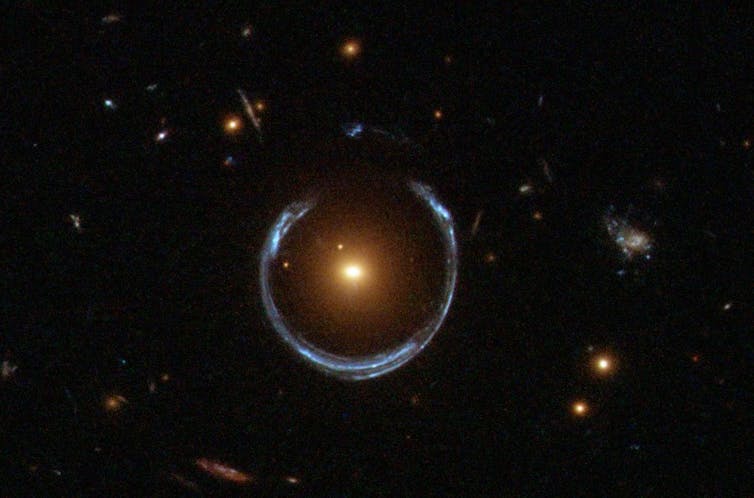
Gravitational lens mirage around a galaxy. NASA

We plan to further investigate this interesting phenomenon. It could also be responsible for the high variability of galactic motion, for which we gather more and more evidence.
Any massive body warps the space and time around it, according to general relativity. As a result, light rays take an apparent turn around the object rather than travelling in a straight line – an effect dubbed gravitational lensing. An extremely interesting test of our finding would be the observation of precise gravitational light deflection by individual galaxies, which is albeit a difficult measurement. Our theory predicts a stronger light deflection for very compact galaxies so, excitingly, it could one day be falsified or confirmed by such a measurement.

Juri Smirnov, Post doctoral researcher of Physics, University of Southern Denmark
This article is republished from The Conversation under a Creative Commons license.
Read the original article.


********************************************

ADDENDUM
Monday 18th February 2019

Only today I came across another theory called Quantised Inertia that also does away with dark matter. In this YouTube video, the originator of the theory (Mike McCulloch) explains a little about it:


There's quite a lot of information out there about this theory and now that I'm aware of it I can investigate further.

********************************************

ADDITIONAL ADDENDUM
Thursday 4th April 2019

This interesting article titled It's Real: Astronomers Just Discovered a Second Galaxy With No Dark Matter and mentions that both galaxies are "ultra-diffuse galaxy - quite large, spread-out, and faint to observe ... about the size of the Milky Way, but with 100 to 1,000 times fewer stars". The findings are said to strengthen the case for dark matter but I'm at a loss to see that. To me, it strengthens the argument that one of the two alternative theories described in this article might be right.