This is complete rewrite of an earlier post in which my purported solution to my Wi-Fi woes turned out to be ineffective. The specific problem concerned only certain networks, specifically the Wi-Fi in my Singapore hotel room and the Wi-Fi at Changi airport. The former required a password and my smartphone connected without a problem but my laptop seemingly connected without needing to supply a password. However, while connected to the Wi-Fi, my laptop would not connect to the Internet. At Changi, I likewise connected to the network but couldn't reach required site to insert my 5 digit password.
A suggestion provided on Tom's Hardware site at least solved the problem at Changi. Open System Preferences under the Apple logo and choose Network:
The suggestion was to click on minus sign in the diagram above while Wi-Fi is selected. Once the Wi-Fi option is deleted, restart the laptop and go back to above screen and click on the positive sign. Choose Wi-Fi from the drop-down menu and then try connecting again. It worked for me. This is something that I'd never tried before but I've now added it to my troubleshooting armoury.
A recent word of the day was pygmalionism, defined as sexual responsiveness directed toward a statue or other representation especially when of one's own making. A biographical note reads:
Greek mythological character. According to the most common version of the myth, Pygmalion was a king of Cyprus and a sculptor who created a beautiful ivory statue representing his ideal of womanhood. He then fell in love with his own creation. In answer to his prayer the goddess Aphrodite brought the statue to life. Source.
Pygmalion is most familiar from Ovid's narrative poem Metamorphoses, in which Pygmalion was a sculptor who fell in love with a statue he had carved. In Ovid's narrative, Pygmalion was a Cypriot sculptor who carved a woman out of ivory ... his statue was so beautiful and realistic that he fell in love with it.
In time, Aphrodite's festival day came, and Pygmalion made offerings at the altar of Aphrodite ... he quietly wished for a bride who would be "the living likeness of my ivory girl." When he returned home, he kissed his ivory statue, and found that its lips felt warm. He kissed it again, and found that the ivory had lost its hardness. Aphrodite had granted Pygmalion's wish.
Pygmalion married the ivory sculpture changed to a woman under Aphrodite's blessing. In Ovid's narrative, they had a daughter, Paphos, from whom the city's name is derived.
Ovid's Pygmalion has inspired many works of literature and has been the subject of several notable paintings and sculptures. For some reason, the popularity of the Pygmalion myth soared in the 19th century. Two famous works of art related to Pygmalion are:
Pygmalion and Galatea by Auguste Rodin modelled 1889, carved ca. 1908–9
George Bernard Shaw's play Pygmalion is of course well known and this play spawned two successful film version: the eponymous 1938 film and 1964's My Fair Lady.
I've long been scrutinising my diurnal age and tweeting my findings. Lately organising information about my daily number in Airtable. Occasionally I've presented my number using an ornate font, such as a made available at sites like fontspace.com. Typically, I'll display the number as large as possible (often 200 point size) and then take a screenshot of it. I'm now considering doing this on a more regular basis and experimenting with a wider variety of fonts. It's a way of adding an extra dimension of interest to the number, rather than focusing purely on its mathematical properties. At the same time, my artistic side gains some stimulation.
This is very simple of course. I just selected a sticker from one of those available in the antique category, pasting and then positioning it as shown. The black and white tone of the original number is preserved and the fob watch reinforces the diurnal significance. I've posted this particular image to Instagram replicating it so that it appears three times in a 1:1 ration image (using an option available under Instagram's Layout App).
ADDENDUM: I've since started an Instagram username of Numbered_Daze where I post my diurnal age daily, using a different font each time. This was today's post (12th September 2018) and the font used is called Gears:
I've begun experimenting with a new app called Airtable that promises good things. Here is a August 2017 review from PC News.
Airtable is a relational database tool that doubles as an online collaboration service. Before you brush it off as boring because of the word "database," take a good look at Airtable. It's highly visual and it facilitates meaningful conversation, too. Businesses might use it to manage CRM, and individuals might use it to create inventories of collections they own. Airtable is different from older database management systems because it looks like an app that anyone with an iPhone could use. And because you use Airtable to look at information differently, as you do with kanban boards, it makes the tool suitable for new, collaborative uses. Airtable is the least intimidating database management system I've seen, and it comes with an excellent array of templates to help you understand how other people use it, too. It's the database management app for teams that don't ever want to use the word "database." It still has room to grow, but Airtable is already a great service for teams who need it.
You can use it from within a browser or download an app to your computer or mobile device. The functionality seems the same in either case. I've started using it a way of coordinating the data associated with my tracking the number of days I've been alive and examining the mathematical significance of the number using both WolframAlpha and the Online Encyclopaedia of Integer Sequences (OEIS). I keep track of the days using the calendar on my laptop, examine the number and then tweet about what I've found. The tweet generally contains a link to the relevant OEIS entry as well as screenshots from OEIS or WolframAlpha (sometimes both). If the entry is particularly interesting I might post something to my Mathematics blog.
The advantage of Airtable is that I can set up a table, create a date field and use this as a calendar. I can then add various other fields including:
a key field called number e.g. 25185 (which is my number for today)
a multiple select field enabling me to choose from prime, two factors, three factors or four or more factors
a name field showing the factors if the number is composite or just the number itself if it's prime
a link field containing the URL of the associated tweet on Twitter
a link field containing the URL of the associated OEIS entry
a link field containing any other relevant URL
a long text field in which information about the number can be included
an attachment field
A screenshot is included below shows the grid view (but the calendar view just looks like a regular calendar):
The free version allows up to 1200 records per database with an unlimited number of databases. That's over three years of daily entries, following which I can simply duplicate the database, clear it of records and start afresh. What the free plan offers at the moment is shown in the attached graphic. There is a limit of 2GB of attachments per database.
So far I'm quite happy with the interface and its ease of use. One can only hope that the company doesn't change its base tier like Evernote did. It's certainly about time that relational databases were made a little more user friendly. The company has just introduced a new feature called Blocks but this isn't available to free users like myself.
Of course, I've only just started entering records but in time I'll be able to quickly search find all primes because that's a choice in my multiple select field. Similarly, I'll be able to find all semiprimes because that's another choice in my multiple select field. Additionally, I can search by date and by number. Given that the factors are listed in the factor field, I can also search by factor e.g. what are all the numbers with 23 as a factor. All this will make analysis of the data much easier. I'm sure I'll add other fields and modify the database in various ways as time goes by but I feel I'm off to an encouraging start.
UPDATE: as of 22nd March 2018, I'm still very pleased with this app. Today I added a 152 KB PDF file an attachment to my daily record. After all, I supposedly have 2Gb of storage space per base and even uploading an attachment of that size, I would only use up 54 MB of data.
It was Bobby Fischer's birthday yesterday. He was born March 9th 1943 and would have been 75 now had he lived. However, he died in 2005 but Chess Base featured a wild game that he played with Tal back in 1960 in Leipzig. Black adopted the French Defence, Winawer Variation, and the game went like this (Fischer is White: there's still a glitch in the display below, the names show up in the preview but not in the final display):
Tal draws of course by perpetual check, his only recourse because of his material disadvantage but it is certainly a short and sharp game, very much in Tal's style. I retrieved the game from chess.com. According to that site's database, they played a total of 13 games, each of them winning four of apiece and drawing the remaining five. All Tal's wins date from 1958 to 1959 when Fischer was still quite young. From 1960 onwards, Tal never defeated Fischer. Tal was not that much older than Fischer at the time, being born in 1936 in Riga, Latvia. The table below summarises their rivalry:
Tal was world champion in 1960 after defeating Mikhail Botvinnik but the latter regained the title the following year. Tal won the strong Bled tournament in 1961, even though he lost his individual game with Fischer.
Getting back to the French Defence however, it's interesting to remember how Alpha Zero, playing White, recently crushed Stockfish when this engine replied 1...e6 against 1.e4. Here is an example of one such game:
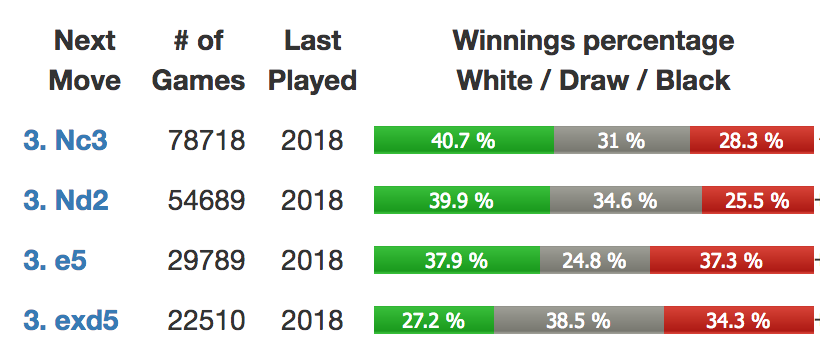
As regards the Winawer Variation of the French Defence, it does tend to produce sharp games such as the one between Fischer and Tal shown above. After 1.e4 e6 2.d4 d5, the four main variants are:
These statistics are taken from 365chess.com. Many other third moves for White are listed but the number of games played using them fall off sharply. For example, the analysis of the fifth most common move 3.Bd3 is based on only 997 games. However, several of these variants yield good results for both White and Black with the number of draws shrinking. Here are the next three most popular moves by White:
The Elephant Gambit was played against me in one of my blitz games on chess.com. I can't recall how I fared but I remember being surprised and it's certainly a good choice by Black when playing blitz chess. The essential position is shown below:
Here is an interesting video of a game involving this gambit that was played in the middle of the nineteenth century:
There is an interesting collection of games involving the elephant gambit on chessgames.com, all involving wins for Black. Here is the most recent game shown on that site:
Certainly an interesting game as well. 365chess.com has a useful analysis of the main variants of this opening:
As the chart shows, 3.exd5 or 3.Nxe5 offer the best chances for White and by clicking on the possibilities in the left-hand column, the common moves in these sub-variants can be explored. For example, 3.exd5 leads to these main variations:
Clearly, Black must proceed with either 3...e4 or 3...Bd6 or else the future looks grim. I like the layout of the 365chess.com website, it's very easy to navigate.
Playing 5-minute chess on the Internet, I got caught by the so-called Fried Liver Attack described by Wikipedia as follows:
The Fried Liver Attack, also called the Fegatello Attack (named after an Italian idiom meaning "dead as a piece of liver"), is a chess opening. This opening is a variation of the Two Knights Defence in which White sacrifices a knight for an attack on Black's king. The opening begins with the moves:
This is the Two Knights Defense where White has chosen the offensive line 4.Ng5, but Black's last move is risky (other Black choices include 5...Na5, 5...b5, and 5...Nd4). White can now get an advantage with 6.d4 (the Lolli Attack). However, The Fried Liver Attack involves a knight sacrifice on f7, defined by the moves:
6. Nxf7 Kxf7
The Fried Liver Attack has been known for many centuries, the earliest known example being a game played by Giulio Cesare Polerio before 1606.
Play usually continues 7.Qf3+ Ke6 8.Nc3 (see diagram).
Black will play 8...Nb4 or 8...Ne7 and follow up with ...c6, bolstering his pinned knight on d5. If Black plays 8...Nb4, White can force the b4 knight to abandon protection of the d5 knight with 9.a3?! Nxc2+ 10.Kd1 Nxa1 11.Nxd5, sacrificing a rook, but current analysis suggests that the alternatives 9.Qe4, 9.Bb3 and 9.O-O are stronger.
White has a strong attack, but it has not been proven yet to be decisive. Because defence is harder to play than attack in this variation when given short time limits, the Fried Liver is dangerous for Black in over-the-board play, if using a short time control. It is also especially effective against weaker players who may not be able to find the correct defences.
In these 5-minute online games, I should decide how to respond to 1.e4 before starting or else I'll continue to get caught off-guard by these aggressive openings. Meanwhile, I'll continue to sharpen my chess skills via online play. I'm gathering experience as I go, summed up thus far by a series of bullet points in answer to the question what have I learned from Blitz chess:
What have I learned about Blitz Chess?
it’s brutal
it’s all about time … if it runs out, you’re dead
there’s no time for equivocation … if in doubt, make an innocuous move or repeat a move
avoid traditional openings, experienced players will have traps ready
always look at the immediate threat from your opponent’s move and respond to it
better still, threaten something yourself to which your opponent must respond
keep playing right to the end, a draw or even a win can be snatched from the jaws of defeat
don’t play when you’re not mentally sharp or in any way distracted (100% focus is needed).