Tuesday, 14 November 2017

CHESS: Strategic Blunders


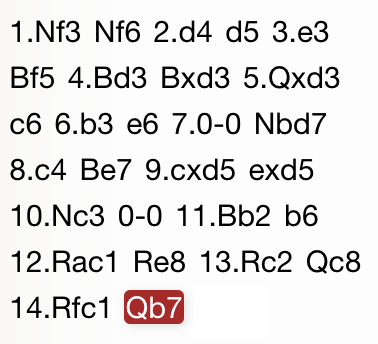
Above is the position after 14 moves of a Queen's Pawn opening. I have the White pieces and Black has just played Qb7. All my pieces are developed and I have a reasonable position in my opinion. I need to develop a strategic plan and the one I foolishly embarked upon involved moving my pawns to a3 and b4 to frustrate a c5 pawn move by Black. As it turned out, Black moved the pawn on b6 to b7 and this did not work in my favour. I'd buried my Bishop and, after I placed the Knight on c5 and Black placed the Knight on c4, my doubled Rooks were useless. Furthermore, the placement of my Knight was far less effective than Black's Knight placement. Black could exchange Bishop for Knight if I Knight became too powerful whereas White didn't have that option. White's buried Bishop was black-squared and Black's Knight was unmovable on its White square. From c4, the Knight bore down on e3 already under pressure from Black's Rook on the half-open file. Worst of all, the King side was completely undefended. Black is able to move his Rook up and across to the Kingside while the Queen and Bishop bear down as well. White's Queen cannot help in the defence.

My strategic plan was a sure loser against any competent player. A far better plan might have been to move the Knight on c3 across to the Kingside and keep bearing down on the half open c file with the two Rooks. This is not without it's problems too however, and so it's interesting to set the computer program (Stockfish) to analysis mode and see what strategy it comes up with. What it comes up with is interesting:


This approach is quite different and quite effective in maintaining the initiative for White. The above sequence of moves leads to the position shown below:


Wednesday, 8 November 2017

CHESS: Ding Lirin - China's highest ranked player ever

Ding Lirin has a peak rating of 2783. It's the highest rating any Chinese player has ever attained. There is an article in ChessBase from the 30th September 2017 about him after his runner-up performance at the World Cup which was won by Aronian. He was born on October 24th 1992 in Wenzhou in Zhejiang Province.


I came across an interesting game of his that was being discussed on a YouTube channel called ChessNetwork. Here is the video creator's introductory comments to the game:
Chess Masterpiece, Immortal Chess Game & Game of the Century are a few of the phrases that come to my mind after observing this magical game from Round 18 of the 2017 Chinese Chess League, played on November 4th. Grandmaster Bai Jinshi played as white against Ding Liren. The opening, a Nimzo-Indian Defense, three knights variation, saw Ding Liren ultimately play the part of some wizard of the game. Many elements of this game reminded me of 13-year-old Bobby Fischer's game against Donald Byrne from 1956, pegged "The Game of the Century". Might this game find its way onto the "Greatest Chess Games of All-Time" list?
Here are the moves:

1. d4 Nf6 2. c4 e6 3. Nc3 Bb4 4. Nf3 O-O 5. Bg5 c5 6. e3 cxd4 7. Qxd4 Nc6 8. Qd3 h6 9. Bh4 d5 10. Rd1 g5 11. Bg3 Ne4 12. Nd2 Nc5 13. Qc2 d4 14. Nf3 e5 15. Nxe5 dxc3 16. Rxd8 cxb2+ 17. Ke2 Rxd8 18. Qxb2 Na4 19. Qc2 Nc3+ 20. Kf3 Rd4 21. h3 h5 22. Bh2 g4+ 23. Kg3 Rd2 24. Qb3 Ne4+ 25. Kh4 Be7+ 26. Kxh5 Kg7 27. Bf4 Bf5 28. Bh6+ Kh7 29. Qxb7 Rxf2 30. Bg5 Rh8 31. Nxf7 Bg6+ 32. Kxg4 Ne5+

Here is the video:

Friday, 3 November 2017

CHESS: Nodirbek Abdusattorov - 2nd Youngest Chess Grandmaster in History

Here is a game played early in 2017 before this latest prodigy, Nodirbek Abdusattorov from Uzbekistan, became a grandmaster at the age of 13 years, 1 month and 11 days.


In this game, Nodirbek is Black and plays the Nimzo-Indian defence against an Indian grandmaster, Nodirbek Abdusattorov, whom he defeats in a mere 19 moves. The game runs thus:

1. d4 Nf6 2. c4 e6 3. Nc3 Bb4 4. Qc2 d5 5. cxd5 exd5 6. Bg5 h6 7. Bh4 O-O 8. e3 Be6 9. a3 Be7 10. Bd3 c5 11. dxc5 d4
12. exd4 Nc6 13. Nge2 Nxd4 14. Nxd4 Qxd4 15. Ne4 Nxe4
16. Bxe7 Bb3 17. Qe2 Nxf2 18. Qxf2 Qxd3 19. Qh4 Bc4

The master stroke comes when Black plays 16. ... Bb3 after which White is finished. Below is the position of the board before Black plays this move. After Black captured the Knight on e4 on his previous move, White captures the Bishop on e7, clearly not expecting what then happened.


As of October 2017, Nodirbek Abdusattorov has an ELO rating of 2498. Lailith Babu on the other hand has a current ranking of 2525 and achieved his highest ranking of 2594 in April of 2014. Here is a list of the top twenty players of all time, taken from Chess-DB. Note how Bobby Fisher still ranks in 18th position with an ELO rating of 2785, achieved in April of 1972 (when I turned 23).


Thursday, 2 November 2017

Chess Diagrams

In the last few months, my interest in Chess has been rekindled in large part due to http://en.chessbase.com/ and the associated online Fritz Chess Program. However, only premium users of ChessBase can make use of the feature that allows the setting up of positions, important when following through an analysis provided in a chess book. For example, I have a book called 101 Chess Endgame Tips by Steve Giddins. Here is a typical position in which White must try to draw the game and not lose it.


I could not see how to set up the position in either the chess program that comes with macOS or Stockfish that I had downloaded. So I downloaded a program called ChessX, an open source program that I found at sourceforge and found that I was able to set the position easily and play it through as outlined in the book. This is a very useful feature. 

The position above leads with proper play to White having the opposition against the Black King and therefore securing a draw. The proper play is: 

1. Kg3!! Kc2 2. Kf2! d2 3. Kf1! Kd1 4. Kf2 Kd2 5. Kf1 Kd3 6. Ke1 Kc4 7. Kd2 Kb5 8. Kc3 Kxb6 9. Kb4 and White has the opposition and draws. Ultimately, the position will end up as shown below where White must be careful to retreat to b1 where the opposition can be maintained whether Black chooses to move the King to a3 or b3.

Gaslighting


The term gaslighting was coined from a movie starring Ingrid Bergman. There is an article about its use in a 21st century context here. The article begins:
If you’re following the commentary surrounding the presidential election, you may have noticed the word gaslighting popping up with increasing frequency. To gaslight means, per the Oxford English Dictionary, to “manipulate (someone) by psychological means into doubting their own sanity.” It’s normally used to describe emotional abuse in a relationship, e.g., a cheating husband who tells his wife she’s crazy, misremembering, or “imagining things” when she points out signs of his infidelity. But thanks to recent campaign tactics, it’s becoming a political term. For example, after Tuesday night’s vice presidential debate, Slate ran an editorial titled “This Wasn’t a Debate. This Was a National Gaslighting,” which cites multiple examples of Mike Pence denying that Donald Trump said things that he actually, provably said. What does that have to do with gaslights, you might ask? The connection actually comes from a popular 1944 suspense film called Gaslight, in which a man (Charles Boyer) conspires to convince his wife (Ingrid Bergman) that she’s going mad.
This got me thinking about terms used in English that derive from movies. I did a little research and come up with some other terms (source dated 2nd January 2014):
1. “You’re killing me smalls” – This famous line from the American movie The Sandlot has become a popular phrase to use in informal situations since the movie was first released in 1993. Usually, if a person is frustrated by another person’s ignorance or lack of commitment to some kind of work, they might use the phrase; “you’re killing me smalls.” 
2. “Sweet” – This famous saying first appeared in the American movie Wayne’s World and became a fashionable way to say ‘great’ or ‘wonderful’. This is one phrase that I use all the time: if something is going perfectly, I will say ‘sweet!’ 
3. “I don’t think we are in Kansas anymore” – This phrase is from a classic movie, The Wizard of Oz, released in 1939. Usually, this phrase is used when the location that you are in is unfamiliar to you, and you feel lost. 
4. “There’s no place like home” – This quote is also from The Wizard of Oz. It’s often used when a person returns from a trip and is happy to be at home. I usually use this idiom after I get home from long trips and lay down on my bed. 
5. “Houston, we have a problem” – This famous quote from the movie Apollo 13, released in 1995, has well and truly entered everyday language in America. If someone is experiencing any type of a problem, this phrase can be used to point it out. 
I'd not heard of the first mentioned phrase and that's probably because its use is largely restricted to the USA.

Tuesday, 13 June 2017

Free Text Books

I stumbled upon a site offering free text books for high school subjects, including A Levels, O Levels and IGCSE. I'd been looking for ebooks designed for IGCSE courses that my granddaughter will be studying when she enters Grade 10 in July. I found text books for five of the courses that she is studying: English, Mathematics, Business Studies, ICT and Modern History. Unfortunately, these textbooks are not from Cambridge University Press as the school requires but are instead from Hodder Education. They seem just as good and are free, as opposed to paying A$40 to A$50 each for the school mandated books. Here is the URL: https://www.gceguide.xyz/e-books


In a country like Indonesia where the cost of these sorts of text books is very burdensome, it seems perverse to require parents to expend hundreds of dollars when perfectly acceptable, free alternatives are available. Admittedly, the books are not paper copies but it would still be cheaper to ask parents to buy a cheap tablet on which to read the ebooks. One advantage is that students would then not have to lug around heavy textbooks in their backpacks.

Nonetheless, it is useful to me because I found a number of A level Mathematics textbooks that I've now downloaded and added to my already extensive collection of e-textbooks. For example, this advanced level Statistics textbook should be helpful as I'm currently embarked on a revision of this topic.

Thursday, 6 April 2017

Practising with g(Math)

I’ve created this page in Google Docs using g(Math). I installed the much anticipated Equatio Chrome extension but it’s a disappointment as far as I can tell. Perhaps I’m missing something. The 12 point Verdana that comprises the text of this blog was chosen in Docs because it is more compatible in size with the images generated.

The links to the images of the mathematical expressions that are created are preserved in Blogger, so that’s an alternative way of getting mathematical expressions into a blog. It seems to be quite fast compared to the alternative in which javascript on a server is accessed and used to convert LaTeX code into mathematics.

The disadvantage is that you can't amend the LaTeX code because it's not there. It was used to create the image of the mathematical expressions and then it's no longer available.

I worked out after some fiddling how to get the equal signs in equations to align. Here is the proof:


Here’s another example of alignment using a different format:


Of course, if the images appear a little large, they can be easily resized:


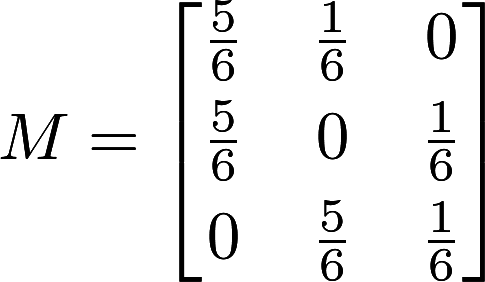
When using Google Docs, the images do take a few seconds to be created but after that they display quite promptly. Here is a matrix.


The following matrix is identical to the one above but it is being displayed with javascript that accesses the MathJax website that renders the code to display the mathematical expression: $$M = \begin{bmatrix} \frac{5}{6} & \frac{1}{6} & 0 \\[0.3em] \frac{5}{6} & 0 & \frac{1}{6} \\[0.3em] 0 & \frac{5}{6} & \frac{1}{6} \end{bmatrix}$$The difference is time between displaying the image and getting the same result by rendering the code is considerable. Google Sites of course also creates images for any LaTeX code inserted but it's far clunkier than for Google Docs (read more about this on my Google Site). With Google Docs, the g(Math) does most of the work for you. Of course, if you're viewing the previous matrix on a device running Android, then all you will see is the LaTeX notation. This is a good reason to use the graphics rather than the LaTeX code in Blogger.

So in summary:
  • Google Sites creates images of mathematical expressions from LaTeX code but it's a little clunky
  • Google Docs creates images of mathematical expressions from LaTeX code but g(Math) makes the process easier
  • Blogger will render LaTeX code if a link to MathJax is inserted into the head section of the template's HTML code OR, as I've done here, the mathematical content can be created first as images in Google Docs and then pasted into Blogger.