My somewhat dated MacBook Pro is still serving me faithfully but I've had problems with getting it to connect with WiFi repeaters.
I have a TP-LINK TL-WA855RE N300 Wi-Fi Wall Plug Range Extender/Repeater/Access Point and was having no end of trouble getting my MacBook Pro to maintain a WiFi connection to it. It would connect but soon an IP conflict message would appear and the connection would be broken. Having become so reliant on WiFi, I'd forgotten that this repeater has an Ethernet port.
When I remembered, I then used a wired connection. My MacBook was assigned an IP address and that was the end of my problems. I need the repeater in my study, which is a little out of range of the TP-Link router, and so the lack of mobility is not a problem. I can simply turn the WiFi back on when I'm elsewhere in the house.
The problem only occurred with the MacBook. My Samsung smartphone experienced no such problems. So the WiFi connectivity problem was never resolved but an alternative connectivity solution came to the rescue. Whether this same problem occurs with the latest MacBooks I don't know.
Of course I don't have a dedicated Ethernet port on my MacBook Pro and so I needed to use a dongle, which fortunately I already had in my possession. With that and an Ethernet cable, I've had no further problems. It's just a reminder that, even in the world of technology, everything old can be new again. Once upon a time, there was no WiFi and Internet connectivity, when there was an Internet to connect to, was achieved via cables. Now, in my study, I'm living in the past.
I was thinking of words that rhyme with sandy and was reminded of Henry Lawson's poem "Andy's Gone With Cattle" that I first encountered when I was in high school. I don't know what a non-native speaker, or even an American, would make of some of this verse. Apart from the place names, there's terms like squatter and Blucher that would be rather challenging, although one might suspect that Blucher is a dog since it "howls all night". According to Wikipedia, the poem was first published in The Australian Town & Country Journal on 13 October 1888.
Anyway, the poem was brought to mind because the name Andy rhymes with sandy. What are some other words that rhyme? RhymeZone provides 79 examples of words and phrases that rhyme with Andy. These are:
brigandi, burgandy, discandy, fernande, fortran d, hard candy, islandy, jimdandy, leylandii, mint candy, mutande, rock candy, unhandy, verdandi, verthandi, viande
Words of four syllables:
alibrandi, barley candy, chocolate candy, come in handy, cotton candy, operandi, sugar candy, vallegrande
Words of five syllables:
peppermint candy
Words of six syllables:
modus-operandi, modus operandi
I've marked in bold the words that would be familiar to most native speakers (I've not bothered marking all the terms relating to the different types of candies, although I should mention here that a candyman once referred to a person who sold illicit drugs - the term is a little dated now). I had to look up some of the other terms and many are not really English words at all or they are archaic. Some that are in use either as given names or words include:
Figure 1: Andie MacDowell, aged 25
Andie seems to be used as the female equivalent of "Andy" e.g. the actress Andie MacDowell (see Figure 1).
Brandi is a fairly popular female given name (1 in 1818 females; popularity rank in the U.S. is 320) e.g. the singer Brandi Carlile
Mandy is a somewhat popular female given name (1 in 3448 females; popularity rank in the U.S. is 475) e.g. the model Mandy Rice-Davies (associated with the Profumo scandal in 1960's British politics)
standee is a lifesize cardboard cutout (usually of a celebrity) e.g. he had his picture taken with a standee of the president"; also someone who stands in a place where one might otherwise sit (as a spectator who uses standing room in a theatre or a passenger on a crowded bus or train) e.g. the allowed number of standees is posted".
jimdandy is something excellent of its kind e.g. the bike was a jimdandy or he's a jimdandy of a soldier" (the term is maybe a little old-fashioned nowadays)
One phrase that's left out is fine and dandy explained as:
All right, excellent, as in What you're proposing is fine and dandy with the rest of us. This redundant colloquialism (fine and dandy both mean “excellent”) today is more often used sarcastically in the sense of “not all right” or “bad,” as in You don't want to play bridge? Fine and dandy, you've left me without a partner.Source
This post, like others, if part of my effort to make the learning of the English language more interesting via rhymes, alliteration and word games. Before leaving however, I'll return to the beginning of this post and make further mention of blucher, defined as a strong, leather half boot (see Figure 2).
Figure 2
The use of the term to describe a typeof shoe is perhaps due to the tough old Prussian general of the same name who fought against Napoleon. Wikipedia has an entry about him. Figure 3 shows a photo of him sporting his Star of the Grand Cross of the Iron Cross: Blücher and Hindenburg are the only German military officers to have been awarded this honour).
Figure 3
The term squatter in the context of the Lawson's poem can only be understood in terms of Australian history. Here is a link to the Wikipedia article about the subject but the key point is that:
... the term ‘squatter’ came to refer to a person of high social prestige who grazes livestock on a large scale (whether the station was held by leasehold or freehold title). In Australia the term is still used to describe large landowners, especially in rural areas with a history of pastoral occupation.
So in the poem, the squatter is more or less the landlord.
As part of my preparation for perhaps teaching English to non-native speakers at some point in the future, I've prepared another unit that has rhyme as its foundation and that then goes on to explore the occurrences of a very common and versatile word in the language, namely "double".
Song of the Witches:
“Double, double toil and trouble” BY WILLIAM SHAKESPEARE (from Macbeth)
Double, double toil and trouble; Fire burn and caldron bubble. Fillet of a fenny snake, In the caldron boil and bake; Eye of newt and toe of frog, Wool of bat and tongue of dog, Adder's fork and blind-worm's sting, Lizard's leg and howlet's wing, For a charm of powerful trouble, Like a hell-broth boil and bubble. Double, double toil and trouble; Fire burn and caldron bubble. Cool it with a baboon's blood, Then the charm is firm and good.
Investigation: Who was William Shakespeare and when did he write this poem?
Other words that rhyme with double, trouble and bubble:
hubble
The Hubble Space Telescope (HST) is a space telescope named after renowned astronomer Edwin Hubble. It was launched in 1990 and is one of the great observatories of NASA.
redouble
make or become much greater, more intense, or more numerous e.g."we will redouble our efforts to reform agricultural policy".
rubble
waste or rough fragments of stone, brick, concrete, etc., especially as the debris from the demolition of buildings e.g. "two buildings collapsed, trapping scores of people in the rubble"
stubble
the cut stalks of cereal plants left sticking out of the ground after the grain is harvested e.g. "a field of stubble" or short, stiff hairs growing on a part of the body that has not been shaved for a while, especially on a man’s face e.g. "she ran her fingers over the dark stubble on his cheeks".
Phrases involving the word double:
double trouble as opposed to simply trouble.
What's the difference between regular trouble and double trouble?
double down is an intransitive verb.
If I double down in an effort to get a job done, what am I doing?
double up / double over
If I double up or over in pain, what is happening to me?
double back
If I double back to retrieve something that I left behind, what am I doing?
double take
If I glance at someone and then do a double take, what am I doing?
double-A
I bought some double-A batteries. What type of batteries are these?
double agent as opposed to a regular agent.
What is the difference between a regular agent and a double agent?
double or nothing
I'm gambling and I decide to go for double or nothing. What am I doing?
double-action as opposed to a regular action.
What is the difference between a double-action gun and a regular one?
double-edged
What does it mean to say that the consequences of my actions can be double-edged?
double-dare as opposed to a regular dare.
What is the difference between a double-dare and a regular dare?
double-barrelled
What characterises a double-barrelled question?
double-breasted
What does a double-breasted suit look like?
double-parked
What do it mean if I say I'm double-parked?
double-check
If I double-check to make sure a complicated device is in working order, what am I doing?
double-quick
If I change my clothes in double-quick time what am a doing?
double life as opposed to a regular life.
If I lead of live a double life, how is this different from leading or living a normal life?
double bed as opposed to a single bed
How does a double bed differ from a single bed?
double standard
If I'm accused of having double standards, what might I be guilty of?
double time
If I'm paid double time on public holidays, what characterises this rate of pay?
on the double
If I'm told to clean up my room on the double, what am I meant to do?
time and trouble
If I take a lot of time and trouble to do something, what am doing?
stunt double
If an actor uses a stunt double in an action scene, what is the actor doing?
double entendre
Accidental humour sometimes involves a double entendre. For example, "The children made nutritious snacks" can be interpreted in two different ways. What are they?
I noticed that Google Docs was using CodeCogs to render LaTeX into image gifs. CodeCogs at https://www.codecogs.com/latex/eqneditor.php provides an interface whereby LaTeX code can be generated quite easily together with an image of what the code would produce if rendered properly (and therefore to be used when the code can't be rendered properly). Here is the interface:
Figure 1: interface that meets the user on CodeCogs
The code can be copied into a document that interprets the LaTeX code and the result is as shown here --> \( \int_{0}^{1}x^3 dx=\bigg [\frac{x^4}{4} \bigg]_0^1\).
The image produced on the site can be simply dragged and dropped:
Alternatively, the HTML code can be inserted into the web page and the image called up from CodeCogs. The result is the same except for the pop up text box that appears when you hover over the image:
These sorts of services are useful for those who lack confidence in creating LaTeX code but there are limitations to what can be produced. There's no substitute for being able to code directly. One site that provides this facility is Overleaf, an online LaTeX editor. Projects that are created can be stored on the site and printed out if desired. The free plan only allows for solo use, no collaborators. There are paid plans that allow for collaboration and provided additional features such as synching with Dropbox and GitHub, full document history, track changes etc. Of course, if you're using a Mac like me, you can download the free program TeXShop to your computer and simply work from there, no online access required. Questions can be posed and solutions hopefully provided on StackExchange.
The article below appeared in The Conversation on February 1, 2019. I was drawn to it because I've always been suspicious of the notions of dark matter and dark energy. The article below proposes that a modification to how gravity works may eliminate the need to include unseen and undetected dark matter and energy in cosmological modelling.
****************************
Dark matter may not actually exist – and our alternative theory can be put to the test
Juri Smirnov, University of Southern Denmark
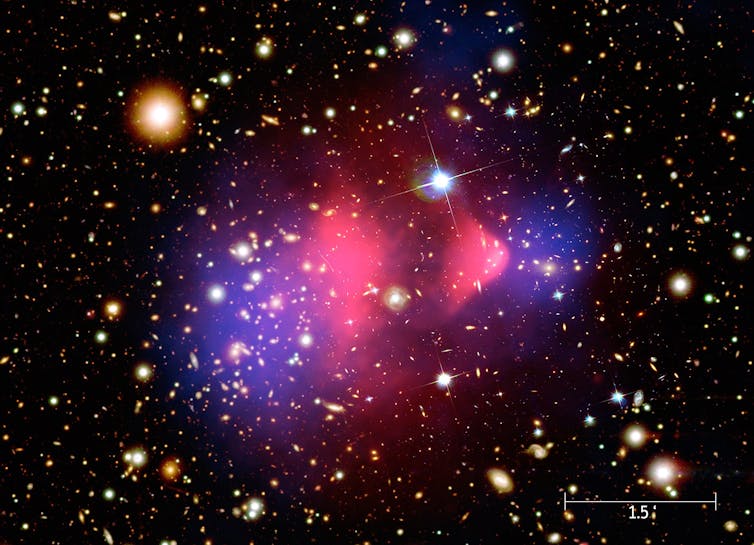
The bullet cluster. NASA/CXC/M. Weiss
Scientists have been searching for “dark matter” – an unknown and invisible substance thought to make up the vast majority of matter in the universe – for nearly a century. The reason for this persistence is that dark matter is needed to account for the fact that galaxies don’t seem to obey the fundamental laws of physics. However, dark matter searches have remained unsuccessful.
But there are other approaches to make sense of why galaxies behave so strangely. Our new study, published in the Journal of Cosmology and Astroparticle Physics, shows that, by tweaking the laws of gravity on the enormous scales of galaxies, we may not actually need dark matter after all.
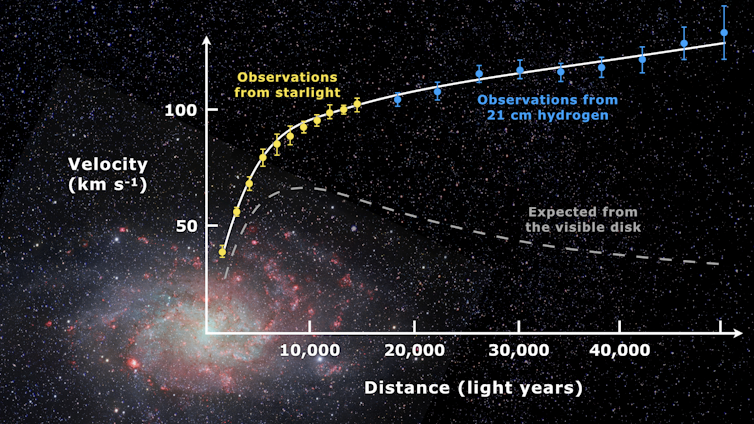
The Swiss astronomer Fritz Zwicky discovered in the 1930s that velocities in galaxy clusters were too high to account for how much matter we could see. A similar phenomenon was described by several groups of astronomers, such as Vera Rubin and Kent Ford, when they studied the motion of stars at the far edges of the Andromeda Galaxy.
The velocities of the stars far from its centre were expected to decrease, as they experience less gravitational force. That’s because, according to Newton’s second law of motion, the gravitational pull on orbiting matter can be equated to a product of its mass and acceleration (which is related to velocity).
Rotation curve of spiral galaxy Messier Triangulum.Mario De Leo/wikipedia, CC BY-SA
However, the measurements showed that there was no such decrease in velocities with distance. That led scientists to believe there must be some invisible matter there to create a stronger gravitational pull and faster stellar motion. In the past decades, countless other probes of gravitating systems at very large length scales indicated the same problem.
Beyond dark matter
The mystery of what dark matter actually is remains the ultimate challenge of modern fundamental physics. The core question is whether it is indeed a missing mass source, such as a new type of matter, or whether the gravitational law is simply different at gigantic length scales.
While the first option seems very tempting, we haven’t actually found any dark matter yet. Also, while gravity laws are well tested within the solar system, one has to be careful extrapolating this to scales which are at least one billion times larger.
One well known attempt to get rid of the need for dark matter is Modified Newtonian Dynamics (MOND), which suggests that Newton’s law of gravity becomes irregular when the gravitational pull is very weak – as is the case in the outer regions of the galaxy. But this theory, although successful in many respects, hasn’t passed the same stringent tests as our standard model of cosmology, which includes dark matter.
The main problem is that MOND cannot explain the missing mass problem in galaxies and galaxy clusters at the same time. Another very strong argument against MOND is based on the observation of colliding galaxy clusters, where the stars of each galaxy pass through each other, but the gas clouds stick together and stay behind. A famous example is the Bullet Cluster, which consists of two such colliding clusters. Observations suggest that dark matter follows the stars in these events, which have a lower total mass than the gas cloud. MOND cannot explain why that is.
Space bubbles
We set out to tweak the laws of gravity in a different way. Our approach assumed that a phenomenon known as Vainshtein screening is at work. This suggests that each sufficiently dense, compact object in space generates an invisible sphere around it which determines how the laws of physics behave with growing distance. This sphere is a theoretical concept to help us understand the difference between small and big scales, rather than an actual physical membrane.
According to our theory, within this bubble the laws of ordinary Newtonian gravity that we see in our solar system hold for objects interacting with the massive body at the centre. Outside the bubble, the theory suggests that the gravitational pull by the central object can be significantly enhanced – even though there is not more mass present.
The bubble size would be proportional to the mass of the central object. If, for example, in a galaxy this sphere has a radius of a few thousand light years – a typical distance at which signs of dark matter is observed – the corresponding sphere of our sun would have a radius of 50.000 astronomical units (one such unit is the distance between the sun and the Earth). However, the edge of the solar system is only 50 astronomical units away. In other words, there are no objects we could observe that far from the sun to test whether the sun has a different gravitational pull on them than it has on Earth. Only the observation of entire systems very far away allows us to do that.
The surprising effect is that the size of the Newtonian bubble grows with the enclosed mass in a particular way. This means that the law of gravity changes at different length scales in galaxies and clusters of galaxies respectively and therefore it can explain the apparent dark matter in both systems simultaneously. That’s not possible with MOND. Furthermore, it is consistent with the observation of the Bullet Cluster. That’s because the gas clouds left behind in the collision are not compact enough to generate a sphere around them – meaning that the apparent dark matter is only notable around the more compact stars. MOND doesn’t distinguish between stars and gas clouds.
To our big surprise, our theory allowed us to explain the stellar velocities in galaxies a lot better than with Einstein’s general relativity, which allows for dark matter to exist. So there may actually be less mysterious dark matter out there than we think – and maybe even none at all.
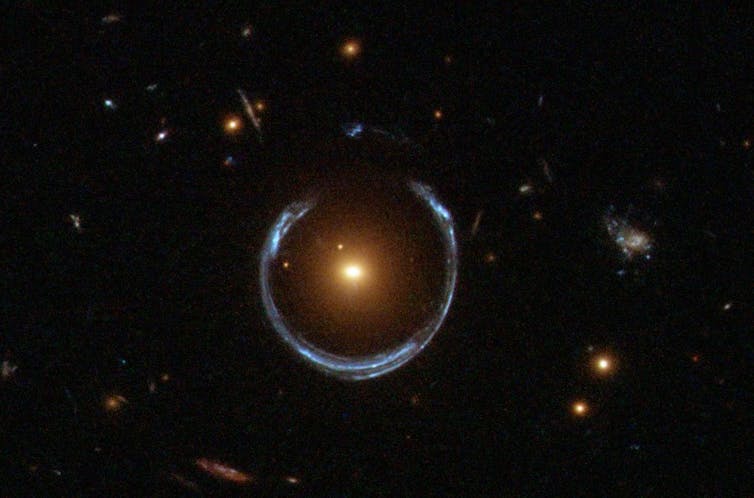
Gravitational lens mirage around a galaxy.NASA
We plan to further investigate this interesting phenomenon. It could also be responsible for the high variability of galactic motion, for which we gather more and more evidence.
Any massive body warps the space and time around it, according to general relativity. As a result, light rays take an apparent turn around the object rather than travelling in a straight line – an effect dubbed gravitational lensing. An extremely interesting test of our finding would be the observation of precise gravitational light deflection by individual galaxies, which is albeit a difficult measurement. Our theory predicts a stronger light deflection for very compact galaxies so, excitingly, it could one day be falsified or confirmed by such a measurement.
Juri Smirnov, Post doctoral researcher of Physics, University of Southern Denmark
This article is republished from The Conversation under a Creative Commons license. Read the original article.
********************************************
ADDENDUM
Monday 18th February 2019
Only today I came across another theory called Quantised Inertia that also does away with dark matter. In this YouTube video, the originator of the theory (Mike McCulloch) explains a little about it:
There's quite a lot of information out there about this theory and now that I'm aware of it I can investigate further.
********************************************
ADDITIONAL ADDENDUM
Thursday 4th April 2019
This interesting article titled It's Real: Astronomers Just Discovered a Second Galaxy With No Dark Matter and mentions that both galaxies are "ultra-diffuse galaxy - quite large, spread-out, and faint to observe ... about the size of the Milky Way, but with 100 to 1,000 times fewer stars". The findings are said to strengthen the case for dark matter but I'm at a loss to see that. To me, it strengthens the argument that one of the two alternative theories described in this article might be right.
From time to time, I'll insert a chess game into this blog, played against Fritz on Chessbase. My main purpose in doing this is to keep practising how to insert a chess game into a blog or else I'll forget how to do it before very long. A secondary purpose is to keep a record of interesting games, preferably ones that I win but not exclusively. Here goes:
There is a glitch in this game. White's 33rd move is 33.b8+Q, meaning that the pawn queens with check, but this was not recognised and play stopped at Black's 32nd move. The only way that I found to proceed was simply to write 33.b8. Ah well, nothing's perfect. To be honest, I blundered in this game on my ninth move. I forgot that my queen was vulnerable to a discovered attack from the black bishop after the knight moves away. In the original game, I played 9.e3 and black countered with 9...Nxd4. Oops! After my reconsidered 9.Qc2, I didn't make any more blunders and went on to win in grand fashion against a handicapped Fritz playing at club level.
The Cambrian explosion or Cambrian radiation was an event approximately 541 million years ago in the Cambrian period when most major animal phyla appeared in the fossil record. It lasted for about 20–25 million years. It resulted in the divergence of most modern metazoan phyla. The event was accompanied by major diversification of other organisms.
Before the Cambrian explosion, most organisms were simple, composed of individual cells occasionally organised into colonies. Over the following 70 to 80 million years, the rate of diversification accelerated, and the variety of life began to resemble that of today. Almost all present animal phyla appeared during this period.
An article in NEW ATLAS caught my attention with the following heading:
Ancient crystals suggest Earth's core is 4 billion years younger than the planet
This is somewhat confusing but the article goes on to explain that the Earth's inner core, in its current solid form, only formed about 565 million years ago.
A new study dates the Earth's inner core to just 565 million years old,
much younger than the 4.5-billion year old planet
I'll quote the article in full:
The Earth is almost 4.5 billion years old, but it's young at heart – literally. Researchers from the University of Rochester have now dated the solid inner core of the planet to just 565 million years, making it a relative toddler compared to the rest of Earth.
Since Earth started life as a growing clump of rock, it's easy to assume that the core is the oldest part of the planet, but that's not quite the case. Today, it's divided into two regions: a solid ball of iron in the inner core, which is surrounded by a swirling pool of liquid iron. When exactly that inner core solidified has long been up for debate, with conventional thinking placing it somewhere between half a billion and 2.5 billion years.
But now the Rochester researchers have narrowed it down to the lower end of that scale. The key to the discovery is the magnetic field that surrounds and protects Earth, and measuring how that's changed over time.
To do so, the team collected samples of ancient crystals from the Sept-Îles Complex in Quebec. Inside these crystals are tiny magnetic needles that preserve a record of the magnetic field at the time they were first locked away in the mineral. The researchers found that about 565 million years ago, the Earth's magnetic field was the weakest it's ever been – about a tenth of its current strength – and was on the verge of collapse.
Since life is still here today and we're able to go outside without being bombarded with deadly cosmic radiation, the magnetic field obviously bounced back from that low point. But how? The Rochester team says that a newly-formed solid inner core could be responsible. The Earth's magnetic field is generated by the flowing fluid iron, in a process called a geo-dynamo.
The team says Earth has probably had a weak geo-dynamo for billions of years, created by a core that was mostly molten iron. But this process slowed down over time, until that turning point 565 million years ago when it was stabilised, possibly by the arrival of the solid inner core we know today.
"This is a critical point in the evolution of the planet," says John Tarduno, corresponding author of the study. "The field did not collapse because the inner core started to grow and provided a new energy source for the formation of the geo-dynamo."
The team says the idea is backed up by other data sets and simulations, but at will need more work to confirm it. The study doesn't just help us understand our own planet a bit better – it could aid in the search for exoplanets that are capable of supporting life.
"The same factors that drive dynamos on Earth might affect the magnetic shielding on exoplanets," says Tarduno. "It could be the case that some planets don't have long-lived dynamos and those planets would not have the magnetic shielding we have, meaning that their atmosphere and water might be removed."
The research was published in the journal Nature Geosciences.
John Tarduno's comment "This is a critical point in the evolution of the planet" is quite telling and its tempting to surmise that the reason for the Cambrian explosion was the solidification of the inner core and the resultant increase in strength of the Earth's magnetic field and the resultant protection that magnetic shielding gave to emerging life forms.
Left: Earth's core and magnetic field 565 million years ago, at
its weakest point. Right: Earth's current core and magnetic field

 I have a TP-LINK TL-WA855RE N300 Wi-Fi Wall Plug Range Extender/Repeater/Access Point and was having no end of trouble getting my MacBook Pro to maintain a WiFi connection to it. It would connect but soon an IP conflict message would appear and the connection would be broken. Having become so reliant on WiFi, I'd forgotten that this repeater has an Ethernet port.
  The problem only occurred with the MacBook. My Samsung smartphone experienced no such problems. So the WiFi connectivity problem was never resolved but an alternative connectivity solution came to the rescue. Whether this same problem occurs with the latest MacBooks I don't know.