Tuesday, 7 February 2023

Balustrades and Things

 The KATLA word for today was birai meaning ledge or bullustrade. See Figure 1.


Figure 1

The word is not in my Indonesian-English dictionary but Google Translate renders it as "ledge" and bab.la renders it as "balustrade". This got me thinking about what exactly was a balustrade. I had a fuzzy notion and thought I'd investigate further. The diagram shown in Figure 2 was helpful.


Figure 2: source

This site is useful in explaining the difference between a handrail and a bulustrade.
What is a balustrade? 
A balustrade is made up of numerous vertical posts or a solid section which sits at the side of the stair treads. The balustrade on your stairs will be found under the handrail and its main purpose is for safety to stop people from falling over the side of a stair or ramp. Many materials are now used to form the balustrade including metal, wood or glass.

What is a handrail? 
Stair handrail is the term used to describe the railing that runs along the staircase. This is the rail, which can be held with your hand, it is the section that acts as a support or guide. There are requirements for handrails which dictate the height, materials and colours used to ensure good visibility and safety.

Figure 3 shows another type of balustrade and introduces the terms "banister" and "spindle". 


Figure 3: source

By way of explanation, the site offers the following explanation:
Baluster

A baluster is a vertical piece between a railing and other wood or the floor that adds support and safety; a short and decorative post or pillar that supports a top rail. The term baluster actually comes from the Italian word for pomegranate flowers, balaustra, which was chosen because these architectural features sometimes mimic them. Balusters can be made of wood, iron, stone and other materials. The term baluster is interchangeable with the word spindle.

Balustrade

A balustrade is comprised of an assembled top rail, balusters or spindles and often a bottom rail, posts, post caps, and decorative finials. It is a composite made up of individual parts, such as the balusters and a railing/handrail. It can be used indoors or outdoors, for staircases and balconies, as well as decorative structures.

Banister (Bannister)

The banister is actually used as a name for a staircase baluster, although it is commonly referring to the handrail of the structure.
This site gives an overview of the different types of balustrades that includes:
  • wrought iron
  • aluminium
  • wood
  • stainless steel
  • strand wire
  • glass
Figure 4 shows a two part balustrade of glass and strand wire.


Figure 4: source

I think the terminology has been clarified.

Saturday, 4 February 2023

Words for Vegetables in Indonesian

In today's KATLA I was alerted to the fact that kubis is the Indonesian word for "cabbage". See Figure 1.


Figure 1

As can be seen in Figure 1, I started with catur (chess) but with limited success. I knew that there was a "U" in one of four possible positions. My next attempt, bumbu (flavour), fixed the position of the "U" and informed me that there was a "B" in one of the  three possible positions. My third attempt, kubik (cubic), was spectacularly successful and located four letters in their correct positions.

Here is an example of the use of the word kubik:

Persamaan kubik selalu memberikan tiga solusi, meskipun tidak harus berbeda.

A cubic equation always gives three solutions, although they need not be distinct.

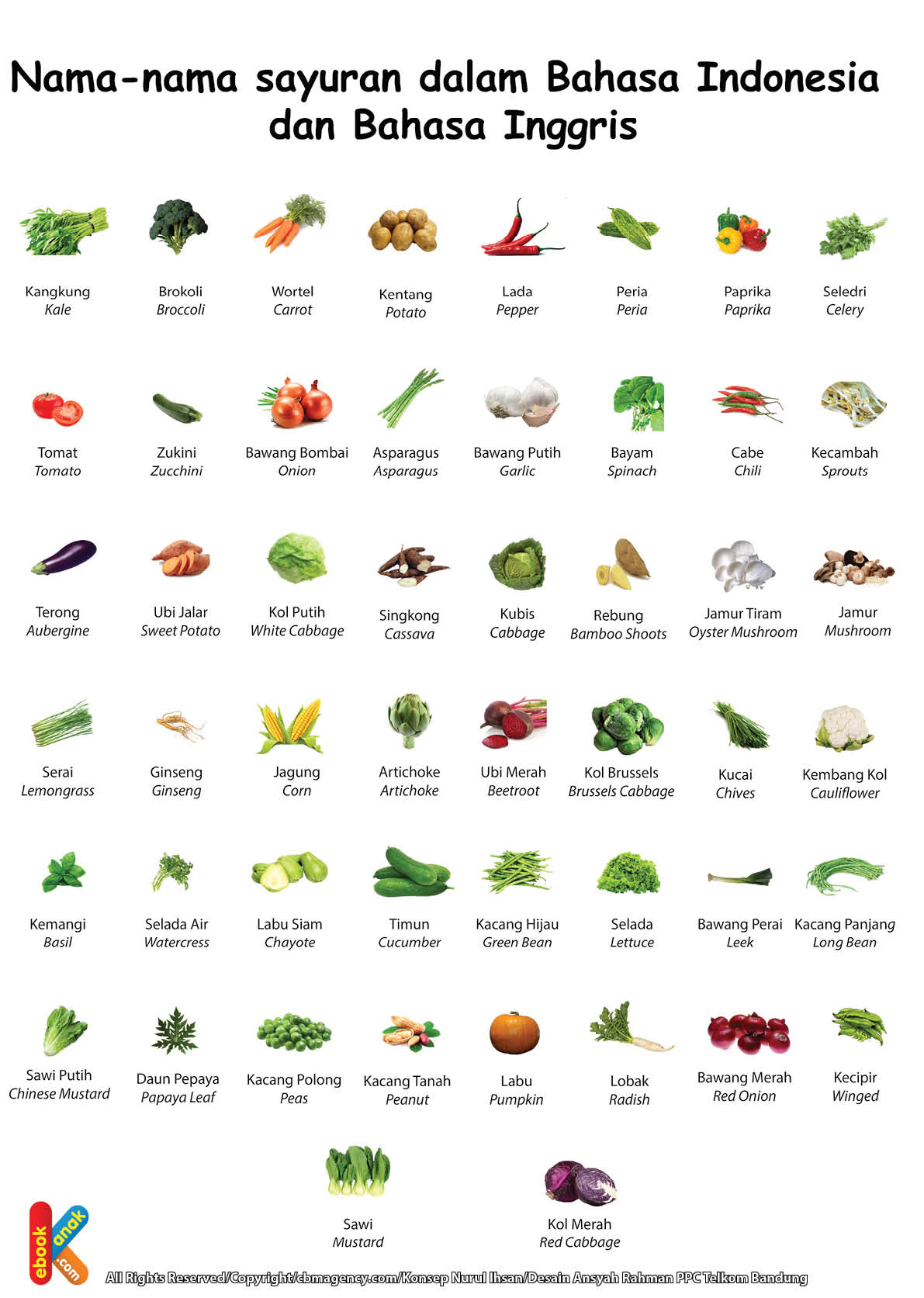
However, it's the Indonesian words for vegetables that I want to concentrate on in this post. See Figure 2 shows a list of English-Indonesian words that will serve as our starting point.


Figure 2: source

I've added this chart to my Pinterest board titled Indonesian Vocabulary. 

As today has turned into tomorrow, I'll include my latest KATLA in Figure 3.


Figure 3

I'd not heard of makar before and had to guess it. Google Translate renders its meaning as "treason" but my Indonesian dictionary returns:
Word: makar 
Short Definition: trick, tactics 
English Definition: 
1. trick, tactics 
2. attack, assault 
3. attack against the government  
Examples: 
Para mahasiswa mengadakan gerakan MAKAR terhadap bekas
Presiden Suharto = Students had organized a movement to ATTACK the
former Presiden Suharto

There is a kata benda or noun, namely makaran, that is translated by Google as "plot". 

Friday, 3 February 2023

The Sun and Moon in Indonesian

As I continue with Katla, the Indonesian version of Wordle, my latest result is shown in Figure 1. All the words shown are acceptable Indonesian words from Katla's viewpoint, even though final and viral are also words in English. The final word, hilal, I had to guess at and I choose it because I knew halal was a word and hilal was very similar. A quick check using Google Translate returned the meaning "new moon". I thought I'd investigate further.


Figure 1


To my surprise, the word didn't appear at all in my Indonesian dictionary that I have sitting on the hard drive of my laptop as a PDF. However, there was an entry in the Indonesian Wikipedia that states:
Hilal adalah bulan sabit muda pertama yang dapat dilihat setelah terjadinya konjungsi (ijtimak, bulan baru) pada arah dekat matahari terbenam yang menjadi acuan permulaan bulan dalam kalender Islam. Biasanya hilal diamati pada hari ke-29 dari bulan Islam untuk menentukan apakah hari berikutnya sudah terjadi pergantian bulan atau belum. Hilal juga merupakan bagian dari fase – fase bulan.

Google Translate renders this as: 

Hilal is the first young crescent that can be seen after conjunction (ijtimak, new moon) in the direction near sunset which is a reference to the beginning of the month in the Islamic calendar. Usually the new moon is observed on the 29th day of the Islamic month to determine whether the following day has taken place or not. The new moon is also part of the moon phases.

The sighting of this new moon is most important in determining the start of Ramadan. This realisation of what hilal meant motivated me to look at some other astronomical terms. One that I'm familiar with is "solar system" that translates as tata surya which is surprising because the word for "sun" is matahari, the eye in the sky. Why is surya used instead? 

I put the following question to ChatGPT:
Why do Indonesians use the word "surya" to refer to the sun when used in the phrase "tata surya" or solar system? The normal word for the Sun in Indonesian is "matahari".

It thought about it for a good while and then provided this quite reasonable response:

The word "surya" is derived from Sanskrit and is commonly used in Indonesia to refer to the Sun in certain cultural and religious contexts. "Tata Surya" literally means "system of the Sun" and refers to the solar system. The use of the term "surya" emphasizes the importance and significance of the Sun in ancient Hindu-Buddhist belief systems that have influenced Indonesian culture. 

The word for the Moon of course in bulan but this word also means "month" which is not surprising as the Islamic world uses a lunar calendar and not a solar one. Thus the Moon marks the months. The phases of the Moon are as follows:

  • bulan sabit - crescent moon (sabit means "sickle")

  • bulan bungkuk - gibbous moon (bungkuk means "hunchback")

  • bulan purnama - full moon (or purnama can be used by itself)

  • gerhana matahari - solar eclipse (gerhana means "eclipse")

  • gerhana bulan - lunar eclipse

  • gerhana cincin - annular eclipse (cincin means "ring")

That will do it for this post.

Thursday, 2 February 2023

Indonesian Language Skills

 I made a post at the start of 2022 titled The Usual Suspects in which I wrote:

With the start of a new year, I usually try to kick start some projects that have languished over the previous year. One of those is my Indonesian language skills. Just as in Mathematics where I examine the number associated with my diurnal age, I thought I might be able to examine, on a daily basis, at least one Indonesian word or phrase that I was unfamiliar or uncertain about. 

I don't think my Indonesian language skills have improved much over the past year unfortunately and I failed to an Indonesian word or phrase on a daily basis. Let's look back at my posts over the years relating to the language:

There's enough material here for some useful revision. The problem with my posts is that I tend not to look back at them once I've made them. I need to keep looking for innovative ways to improve my language skills. 


Let's try chess. What are the Indonesian names for the various pieces and moves? Here are some taken from this website.
  • King - Raja
  • Queen - Menteri
  • Rook - Benteng
  • Bishop - Gaja
  • Knight - Kuda
  • Pawn - Pion/Bidak
  • Check - Skak
  • Checkmate - Skak Mati
  • Chess - Catur
  • Chess Pieces - Bidak Catur
  • Chess Board - Papan Catur
  • Chess Game - Percaturan
Just in conclusion, this tweet caught my eye and I decided to play the game.


I came up with FREEDOM, RELAXATION and PROGRESS. So this could define my year: feel that I have the freedom to experiment in whatever way I choose, enjoy the relaxation that comes from this sense of freedom and sit back and watch as I make awesome progress in Indonesian language skills, guitar playing, mathematics, gardening, chess, meditation or whatever else I find of interest.

It occurred to me that I should make more use of Pinterest. I've had an account for a long while now but haven't made much use of. To this end I've created a board called Indonesian Language and Figure 2 shows my first addition to it. Most of these words I already knew but it's important to be reminded of them and see them in print so that they embed themselves more deeply in my memory.


Figure 1

I've also started playing KATLA again. See Figure 2. It turns out that "kanal" is just the phonetic spelling of the English word "canal".


Figure 2

Wednesday, 1 February 2023

ChatGPT

I thought I'd test of ChatGPT's capabilities by asking it to generate a short story based on my own input. I asked it to do the following:

Write a short story, about 500 words, about two friends meeting accidentally on a city street after not seeing each other for many years. The story should describe their reactions to their changed physical appearance and emotions associated with connecting again after such a long time.

Here is what it came up with:

As she walked down the busy city street, Maria couldn't help but feel a sense of nostalgia wash over her. She hadn't seen her old friend Jake in years, not since they graduated college and went their separate ways. Maria had always wondered what had become of Jake, and she couldn't believe her luck when she spotted him walking towards her from across the street.

At first, Maria wasn't sure it was him. The young man approaching her had a full beard and wore a suit, looking nothing like the scruffy, carefree college student she remembered. But as he got closer, Maria recognized the mischievous twinkle in his eye and the friendly smile that had always lit up his face.

"Jake!" Maria exclaimed, rushing towards him and throwing her arms around him in a hug.

Jake's eyes widened in surprise as he hugged Maria back. "Maria! I can't believe it's you! What are you doing here?"

Maria laughed and stepped back, taking a good look at Jake. "I could ask you the same thing! You look so different!"

Jake chuckled and ran a hand through his beard. "Well, a lot has changed since college. I got a job in finance and moved to the city. How about you?"

Maria told Jake about her job as a teacher and how she had married her high school sweetheart. As they caught up on all the years they had lost, Maria couldn't believe how much they had both changed. But as she looked at Jake, she realized that some things never change. He was still the same kind, compassionate person she had always known, and she was grateful to have reconnected with him.

As they parted ways, Jake promised to stay in touch and the two friends made plans to meet up again soon. As she walked away, Maria couldn't help but feel a warm glow in her heart. It was amazing how one chance encounter could bring old friends back together, and she couldn't wait to see what the future held for her and Jake.

This, I think, is rather impressive. Earlier, I had asked it "what is meant by a zero sum outcome?" and this was the response:

A zero sum outcome is a situation in which one person's gain is exactly balanced by the loss of another person. In other words, the total amount of resources available is fixed, and any gain by one person must be offset by an equal loss by another person.

For example, in a game of chess, each player starts with 16 pieces, and the total number of pieces does not change throughout the game. If one player captures one of the opponent's pieces, they have gained a piece, but the opponent has lost a piece. The total number of pieces remains the same, so the gain of one player is balanced by the loss of the other player.

In economic terms, a zero sum outcome is often used to describe situations in which the total wealth or resources available are fixed, and any gain by one person must be offset by a corresponding loss by another person. For example, if one person earns more money, they may have gained a larger share of the total wealth, but someone else must have lost a corresponding amount.

Overall, a zero sum outcome is a situation in which the total amount of resources remains constant, and any gain by one person must be balanced by an equal loss by another person.

Here's an interesting question that I put to it together with its quite reasonable response:

What do a black hole and a bottomless pit have in common?

A black hole and a bottomless pit both have the property of being extremely deep and seemingly without a bottom. They both also have a strong gravitational force that can draw objects towards them. However, there are some key differences between black holes and bottomless pits.

Black holes are regions in space where the gravitational force is so strong that nothing, not even light, can escape from them. They are formed when a massive star collapses at the end of its life, and they can have a wide range of masses, from a few times the mass of the Sun to millions or billions of times the mass of the Sun.

A bottomless pit, on the other hand, is a hypothetical concept often used in literature and folklore to describe an extremely deep hole or chasm that has no end. It is not a physical object that exists in the real world.

One other important difference between black holes and bottomless pits is that black holes have been extensively studied and their existence has been confirmed through scientific observations, while bottomless pits are purely fictional and do not actually exist. 

Here's another similar type of question along with the response:

What is the difference between an interdimensional portal and a wormhole?

An interdimensional portal is a hypothetical concept that refers to a hypothetical opening or gateway between different dimensions or universes. The idea of interdimensional portals is often used in science fiction and fantasy literature and media as a way to explain how characters can travel between different dimensions or universes.

A wormhole, on the other hand, is a hypothetical tunnel-like structure that could potentially connect two distant points in space-time. The concept of a wormhole is based on the idea that space-time is not a flat, two-dimensional surface, but rather a three-dimensional fabric that can be bent and stretched. According to this idea, it might be possible to create a shortcut through space-time by creating a tunnel-like structure, or wormhole, that would allow an object or a person to travel from one point in space to another point much more quickly than would be possible using normal means of travel.

While both interdimensional portals and wormholes are hypothetical concepts, wormholes are considered to be a more scientifically credible idea than interdimensional portals, as they are based on established principles of physics, such as the idea of space-time being a three-dimensional fabric. However, it is important to note that the existence of wormholes has not yet been conclusively proven, and they remain a subject of theoretical study in physics.

The level of English is excellent and the explanations clear and concise. ChatGPT will readily provide references for further study.

Could you provide some references that might help with additional investigation of interdimensional portals and wormholes?

Certainly! Here are a few references that might be helpful for further investigation of interdimensional portals and wormholes:For information on interdimensional portals, you might want to check out the following resources:

The Wikipedia page on interdimensional portals (https://en.wikipedia.org/wiki/Interdimensional_portal) provides an overview of the concept of interdimensional portals and how they have been used in science fiction and fantasy literature and media.

The TV Tropes page on interdimensional portals (https://tvtropes.org/pmwiki/pmwiki.php/Main/InterdimensionalPortal) provides examples of interdimensional portals in various media, including literature, television, and film.

The SF Encyclopedia entry on interdimensional portals (http://www.sf-encyclopedia.com/entry/interdimensional_portal) provides a more detailed look at the concept of interdimensional portals and how they have been used in science fiction.For information on wormholes, you might want to check out the following resources:

The Wikipedia page on wormholes (https://en.wikipedia.org/wiki/Wormhole) provides a detailed description of the concept of wormholes, including the history of the idea, the theoretical basis for their existence, and the current state of research on this topic.

The Physics Classroom (https://www.physicsclassroom.com/class/relativity/Lesson-4/Wormholes) provides a more in-depth look at the physics of wormholes and how they might potentially be used for space travel.

The British Society for the Philosophy of Science's page on wormholes (https://www.bsps.org.uk/resources/wormholes.html) provides a philosophical perspective on the concept of wormholes and the implications of their potential existence.

I hope these resources are helpful! If you have any further questions, don't hesitate to ask.

Friday, 18 November 2022

Laptop Connectivity Problems

A problem that I encounter almost daily on my 2013 MacBook Pro is a connectivity issue. Whether I'm connected wirelessly or wired via an Ethernet cable from a repeater, I lose the connection and am repeatedly prompted for the password to the WiFi network if I'm connected wirelessly. After a short while the problem goes away and all is well. The problem is annoying but doesn't seriously trouble me.

Nonetheless, I'd like to get to the bottom of it and there are plenty of requests on Internet forums from Linux Mint users for solutions to exactly this problem. The fact that it doesn't make any difference whether I'm connected via WiFi or cable rules out the WiFi hardware driver as the problem. Neither does it matter whether I'm connected to the WiFi repeater or the WiFi router.

The Internet router that I'm using is an ancient one and only operates on the 2.4 Ghz frequency with no support for 5 Ghz or any other frequencies! I don't use Bluetooth on this laptop so I've just now turned it off and I'll see if that makes any difference. It shouldn't but who knows. It's worth a try. Overall, I should be happy that things are working as well as they are given the antiquity of the technology that I'm using.

The operating system that I'm using is Linux Mint 20.3 Cinnamon with the Cinnamon version being 5.2.7. This means that the system is up-to-date. My WiFi adapter is shown in Figure 1.


Figure 1

I'd like to say that things worked flawlessly when I had Mac OS X installed on this laptop but that wasn't the case. Right from the beginning I had IP conflict alerts whenever connected to a repeater. I first encountered the issue when I stayed at a hotel in Singapore that was clearly using a repeater. In my own bedroom, where the WiFi signal was weak, I encountered the same problem when I installed a repeater. I solved the problem by connecting an Ethernet cable from the repeater to my laptop.

Thursday, 3 November 2022

Thoughts on Backing Up My Calibre Library

I thought it was time to back up my Calibre library that now is 39.8 GB in size and so I dusted off my trusty 128 GB SanDisk and thrust it into the USB 3.0 port on my old 2013 MacBook Pro. From previous experience I knew that this would be a slow process but today I got to thinking about how slow. Figure 1 shows the situation.

Figure 1

The USB 3.0 ports on the MacBook Pro can transfer data at the rate of up to 5Gbps. Now that's 5 gigabits per second. There are 8 bits in a byte and 1024 x 1024 bytes in a megabyte (MB) so that translates to a transfer speed of up to 640 MB/s.  For my file transfers I'm achieving a rate of around 4 MB/s which is 160 times slower than the maximum possible! This seems impossibly slow.

However, if we look online we find the following (see Figure 2):

Figure 2

Even SanDisk only claims a speed of up to 100 MB/s for this particular device and  presumably this is for reading of data and not writing. Furthermore, the thumb drive spends more time checking that writing and so if there are many small files (and I am transferring 34,646 of them), the transfer time will be very much longer than if I were transferring a single 39.8 MB file.

On this particular site, it's claimed that 3.0 USB has a 10~20 MB/s write speed and if that's the case then the 4 MB/s for my worst case scenario (thousands of small files) is not unreasonable. Overall it's not a problem for me because I'm in no hurry and I only carry out the backup every couple of months or so.

I'm also merging the latest library with the older one and this probably adds to the checking time as the new folder (every book has its own folder) has to be compared to the older one. It would probably be quicker just to delete the old library and simply copy the new one across.

An alternative approach would be to make a note of any new books added and then drop their folders into the library backup from time to time. On reflection this makes the most sense and the update would then be almost instantaneous given the small file sizes involved. The current library on my MacBook's SSD and the library backup on my SanDisk will be identical once the transfer is complete. This would be a good time to implement such a scheme. I'll test it out and report back.

Even if I don't make a formal note of my added books, it's easy to identify them by looking at the current library (arranged in chronological order) and noting the dates of books that are newer than the time of my last backup. This could be painful if I let too much time elapse before checking because I will have to locate each book's folder in the database and then copy and paste it across. For a few books it's no problem.

ADDENDUM: November 4th 2020

I've tested the folder copying update method out and it works fine. Quick and painless. Definitely the way to go in future. I downloaded Walter Rodney's "How Europe Underdeveloped Africa" after a recommendation by Jeremy Corbyn shown in this tweet.

The classic work of political, economic, and historical analysis, powerfully introduced by Angela DavisIn his short life, the Guyanese intellectual Walter Rodney emerged as one of the leading thinkers and activists of the anticolonial revolution, leading movements in North America, South America, the African continent, and the Caribbean. In each locale, Rodney found himself a lightning rod for working class Black Power. His deportation catalyzed 20th century Jamaica's most significant rebellion, the 1968 Rodney riots, and his scholarship trained a generation how to think politics at an international scale. In 1980, shortly after founding of the Working People's Alliance in Guyana, the 38-year-old Rodney would be assassinated. In his magnum opus, How Europe Underdeveloped Africa, Rodney incisively argues that grasping "the great divergence" between the west and the rest can only be explained as the exploitation of the latter by the former. This meticulously researched analysis of the abiding repercussions of European colonialism on the continent of Africa has not only informed decades of scholarship and activism, it remains an indispensable study for grasping global inequality today.